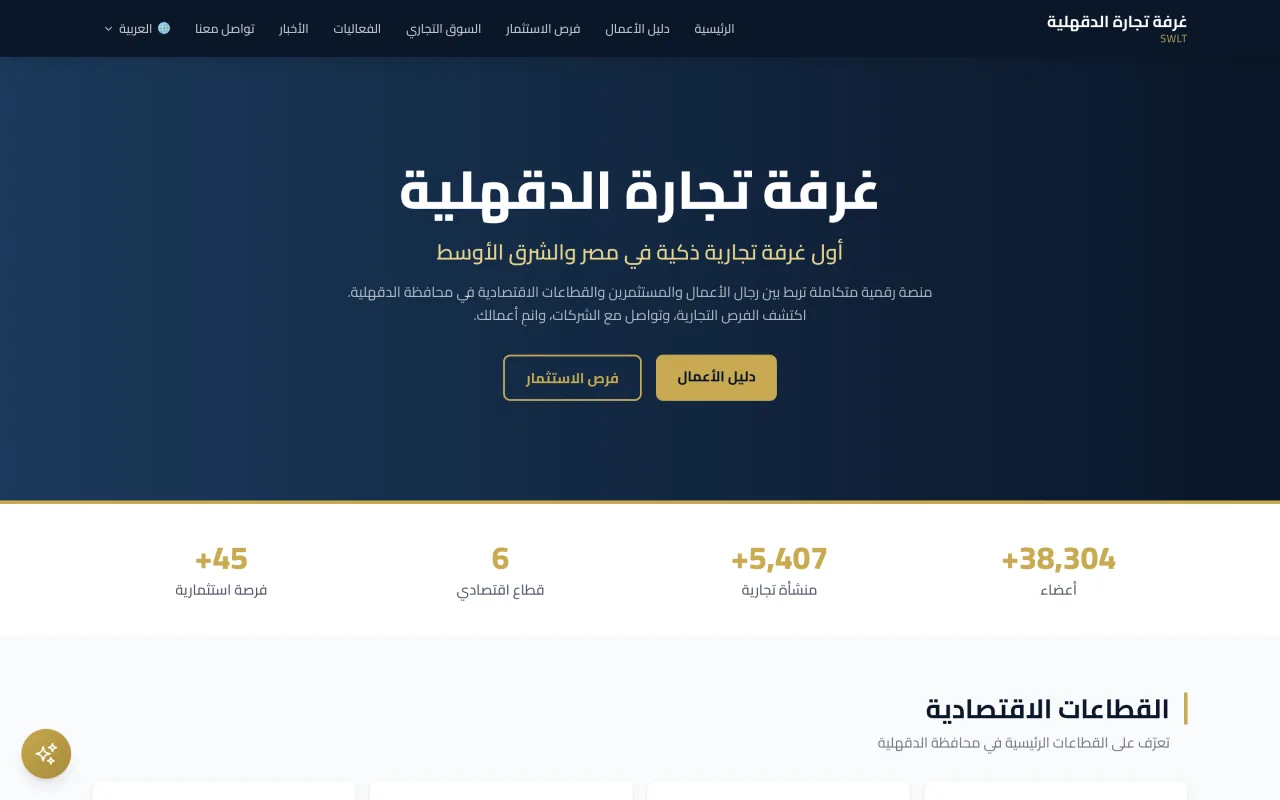
Background
A chamber of commerce holds two things of real value: a verified register of member businesses, and the authority to certify. Both are usually locked in filing cabinets and a phone line.
The brief was to turn the chamber’s institutional role into something members can actually use — and to do it without asking a membership of widely varying digital confidence to learn a complicated system.
The challenge
A certificate is only worth what it can be checked against. A PDF that anyone can edit is not a credential, so the certification had to become verifiable by a third party who has no account and no training.
The harder problem was the register itself. A directory of member businesses is a list nobody reads. The value is not in listing companies — it is in connecting the right two of them, and no member has the time to search a directory hoping to find a match.
Our approach
Certificates were issued with a QR code resolving to a chamber-hosted verification page. Anyone holding the document — a bank, a customs officer, a counterparty abroad — can confirm it in one scan without an account. The chamber’s authority becomes portable.
For the register, we built an AI Smart-Match engine rather than a better search box. It reads what member businesses actually do and surfaces relevant counterparts, so the platform proposes connections instead of waiting to be queried. That is the difference between a directory and a marketplace.
Auctions and the marketplace were layered on the same verified member identity, so a participant is a known, chamber-verified business rather than an anonymous account. Verification is the asset the chamber already had; the platform simply put it to work.
What we delivered
- Member and business register with verified chamber identity
- Digital certificates carrying QR codes that resolve to a public verification page
- Marketplace built on verified member identity
- Auction module for member-to-member trading
- AI Smart-Match engine proposing relevant business connections
- Search across members, businesses, and listings
Stack
The outcome
The chamber now issues credentials that a third party can verify without contacting it, and its member register works as an active marketplace rather than a static list.
For SmartTech it is the clearest institutional-sector proof: a body with a public mandate, a real membership, and a platform that carries its authority rather than just describing it.