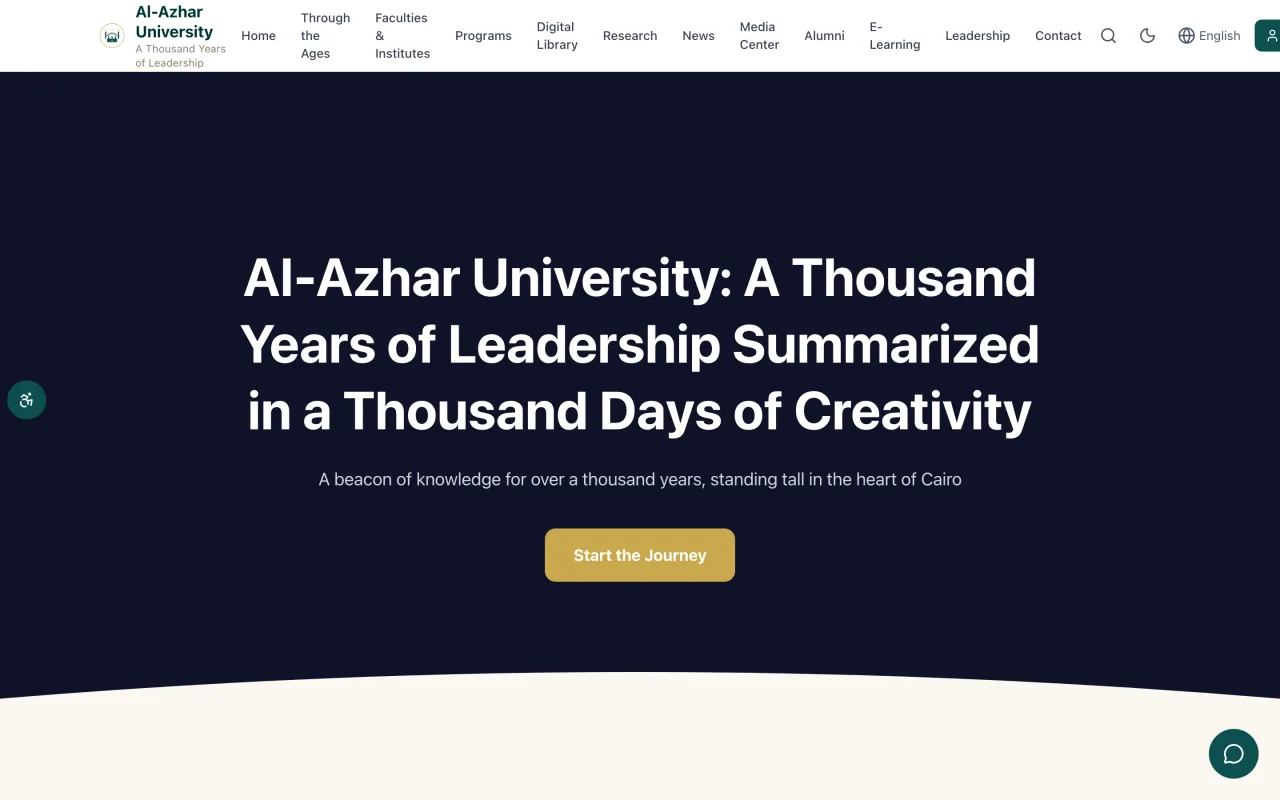
Background
Al-Azhar is over a thousand years old and teaches across 82 faculties. Its audience is genuinely global — prospective students, researchers and institutions reading in Arabic, English and five more languages.
The task was to represent an institution of that scale and age on the web without either flattening it into a brochure or burying the useful information under ceremony.
The challenge
Seven languages is not seven copies of a website. Three of the seven are right-to-left, the content lengths differ enough to break naive layouts, and the navigation has to stay coherent when a menu label doubles in width between languages.
The deeper problem was Arabic. For most multilingual university sites Arabic is the last locale added and it shows — mirrored layouts that break, fallback typefaces, and copy that reads as translated. For Al-Azhar, Arabic reading as an afterthought would have been the one unacceptable outcome.
Our approach
We treated Arabic as the primary locale and built outward from it, which reverses the usual order. Right-to-left is a design state the layout was drawn in, not a transformation applied to a finished English page.
Typography was chosen and self-hosted per script rather than left to browser fallback, so Arabic renders as Arabic was meant to and does not inherit the metrics of a Latin face.
The information architecture was built to survive 82 faculties. Each faculty is a real entity in the structure with consistent fields, so the site presents an institution rather than a set of hand-built pages that drift apart as they are edited.
What we delivered
- Digital platform published in seven languages, three of them right-to-left
- 82 faculties modelled as structured entities, not hand-built pages
- 25+ content pages with consistent institutional statistics
- Arabic-first design with self-hosted typography per script
- Fully mirrored RTL layouts, designed rather than auto-flipped
- Built on Next.js for fast, indexable server-rendered pages
Stack
The outcome
The platform presents all 82 faculties consistently across seven languages, with the Arabic edition reading as an original rather than a translation.
It is the reference project for the studio’s core claim: multilingual done at institutional scale, with the hardest locale treated first instead of last.