Background
Simultaneous interpretation traditionally requires interpreters physically present in booths, which limits an event to the interpreters who can travel to it.
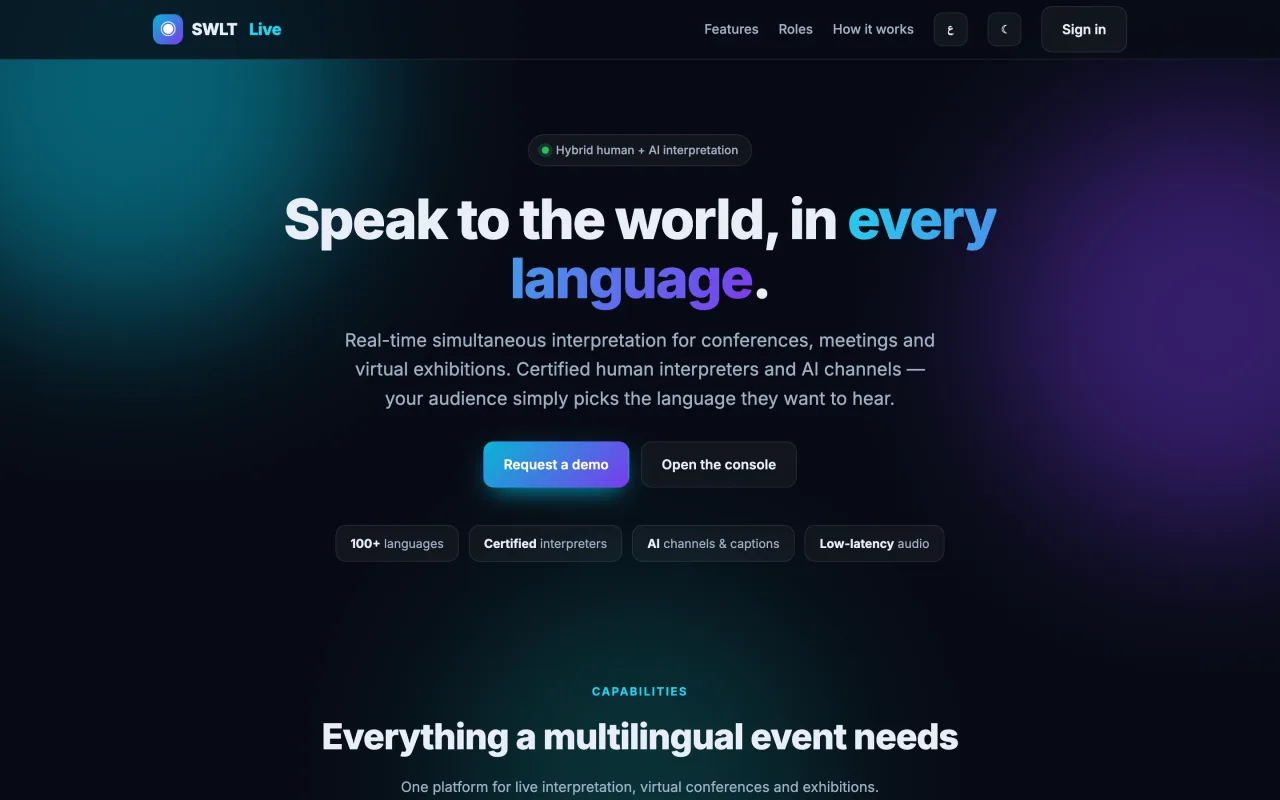
SWLT Live moves that capability onto the network: interpreters work remotely, attendees select their language in the browser, and the event is not constrained by who could get on a plane.
The challenge
Real-time interpretation is unforgiving about latency in a way ordinary video is not. A delay a viewer would never notice in a webinar makes interpretation unusable, because the interpreter is speaking over the speaker and the audience is hearing both.
The second constraint was confidentiality. This platform carries legal and governmental proceedings. Routing that audio through a third-party SaaS whose data handling you do not control was not acceptable, regardless of the vendor’s assurances.
Our approach
We self-hosted LiveKit rather than buying a managed real-time service. That is more infrastructure to own, and it is the only way the audio path stays inside infrastructure the group controls end to end.
The interpretation model is deliberately hybrid rather than fully automated. Human interpreters carry the work where accuracy and nuance are non-negotiable; AI extends coverage into languages and moments where no interpreter is available. Presenting that split honestly matters more than claiming the AI is equivalent.
Language selection was pushed to the listener in the browser, with no install. An attendee joins, picks a language, and hears it — the complexity stays on the platform side, where it belongs.
What we delivered
- Remote simultaneous interpretation for live events, in the browser
- Self-hosted LiveKit infrastructure — audio never leaves controlled infrastructure
- Hybrid delivery: human interpreters with AI extending coverage
- Per-listener language selection with no installation
- WebRTC transport engineered for interpretation-grade latency
Stack
The outcome
Live events run with remote interpreters and browser-based language selection, on infrastructure the group hosts itself.
It is the studio’s hardest engineering reference: real-time audio, self-hosted media infrastructure, and a confidentiality requirement that ruled out the easy path.